Showing posts with label Eamon. Show all posts

Monday, March 22, 2021

Game 52: Eamon Scenario 2 - The Lair of the Minotaur (1979)

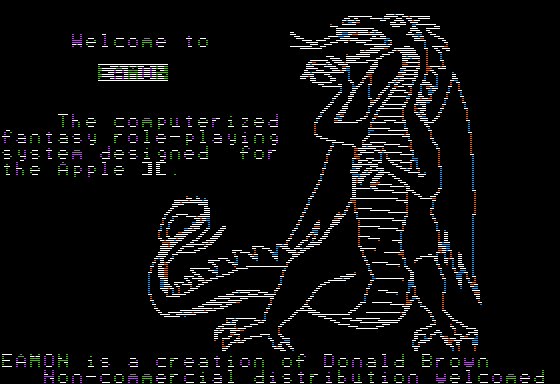
Well, I'm into the weeds with this one.  Lair of the Minotaur is another first for the blog, as it's not a game in itself but rather the second scenario for a game I've already played.  That game - more accurately a game creation system - is Eamon, and I covered it in March last year.  I went over the history in that first post, but all I need to mention here is that Eamon's creator Donald Brown released it for free, and a sizable community (for the time) created quite a number of games for it.

The default scenario for Eamon, The Beginner's Cave, was written by Donald Brown.  The second scenario was also written by Brown, as the game had not quite taken off yet.  There were 10 scenarios created in 1980, and in 1984 there were 41 created, so it ramps up fairly quickly. My current plan is to tackle them all, but I'll get back to that after I've played some more. So far they've been short and easy, but my tune might change if I get to some that are a hassle to get through.  It's also setting a precedent for me to play through loads of non-commercial products, which I'm not super-keen on. I don't mind when those products are historically significant in some way, but I can't see myself playing through hundreds of RPG Maker games. As usual, I'll play these things by ear.

Games created using Eamon visually resemble text adventures, but although they use a command parser I'd say that they are more CRPGs at heart. The number of commands available to the player is minimal, and I've found that combat, gear and improving stats are much more important to play than solving puzzles. One of the biggest draws with Eamon in this regard is the ability to take the same character through different scenarios. I still had my character Artis, who had gone through The Beginner's Cave. He had a Hardiness score of 16, an Agility of 17, and a Charisma of 14. He was also wielding the magic sword Trollsfire, which could be found in that first scenario, and was wearing Plate Armor and carrying a Shield. (Actually, I'm pretty sure Artis has been through Lair of the Minotaur before this, because I played it months ago.  I was badly in need of a refresher before writing this post, so it's likely that this is the second time he's has been through this adventure.)

The background of Lair of the Minotaur is that I had arranged to meet my girlfriend Larcenous Lil in the town of Dunderhaven. Unfortunately, Lil went off to burglarise a local castle, and hasn't been seen since. I snuck into the castle to look for her, only to be ambushed by the local lord and dumped in a pit, presumably the same fate that she suffered. I suppose my goal is to make it out alive from the dungeons beneath the castle, and rescue Larcenous Lil along the way, if possible.

Not gonna lie, I already have a crush on Larcenous Lil.

I'm getting a bit of a Return of the Jedi vibe, but that
movie won't come out for a couple of years.

When the game started I was at the bottom of a long shaft, with an exit leading off to the south. There was a lantern on the floor, already lit, which was handy if a little unlikely.  Thankfully, unlike so many other adventure games of the era, the lantern has no time limit.

Nice of my captors to provide me with an unlimited light source.

Exploring south and west, I came to a room containing a coffin. I opened the coffin, only to be predictably attacked by a skeleton from inside. It missed with its first swipe, and I destroyed it in a single blow with Trollsfire. The skeleton dropped a skeleton key.

South of that was a room containing a large stone, and a mirror with the word "CIGAM" reflected in it. Saying the word backwards - MAGIC - caused an emerald to pop out of the stone. I always appreciate it when a game eases you in with some elementary puzzles.  Some easy successes early on can be very encouraging.

Fear my intellect.

To the east was a river with a boat on the bank, so I got inside and rowed downstream to the south. There were three grottos where I could land, but before I could choose I was attacked by a Killer Rabbit that emerged from the water. As with the skeleton earlier, I killed it with my first swing.

The river continued south, but I ignored that path and landed in the southernmost grotto. (The hints were pretty strong that I'd die if I continued along the river, and experimenting to find out isn't really a viable option when you can lose an experienced character.) There were signs that the grotto had been recently dug up, but without a shovel I wasn't able to investigate, so I kept exploring to the west.

In the tunnel I encountered a floating eyeball creature that was humming to itself, a creature that the game identified as a "Wandering Minstrel Eye". It wasn't hostile, and couldn't otherwise be interacted with, so I gather that it's only in there so that it can be a pun. I love a good pun, but I hate a bad one, so I stabbed this creature in its stupid eyeball so I wouldn't ever have to see it again.

I'll show you some fuckin shreds and patches...

At a crossroads I encountered a Black Knight, who I tried to greet in a friendly manner. He attacked, but after I hit him a couple of times he thought better of it and ran away. I had to track him down before I could put him to the sword. (I'm not sure if this guy is always hostile, or if my Charisma score is to blame. I suspect the former, but in Eamon your Charisma can sometimes decide whether an NPC will be helpful or hostile.) With the crossroads now clear I was able to explore the other grottos, but I found nothing of interest.

Insert obligatory Monty Python reference.

East of the knight's crossroads was a four-way intersection. Further west was a gate that opened to my skeleton key, but I decided not to explore that way yet. To the north I found two things of interest: an "insanity room" that borrowed the Witt's End pun from Colossal Cave Adventure, and a bag with an Acme label. It's not explicitly called out, but this bag allows the player to carry more treasure.

South of the intersection I came to the door of a temple to "Kalimar". In the initial area there was a storeroom where I found a shovel, and another room with a jewel. I backtracked with the shovel to the first grotto, and dug up some gold coins before returning to the temple to investigate the jewel.  There was a warning not to take the jewel, but my greed got the better of me and I decided to risk it. Sure enough, I was damaged by an electric shock, but it wasn't enough to kill me. I took the opportunity to cast a Heal spell to restore my Hardiness.

(There are four spells in the game that you can purchase from a shop between adventures. I had purchased three of the four, but I forgot to really experiment with them. The only one I cast was Heal, which worked on my first try. I gather that like your weapon skills, your skill with spells increases the more you use them. Once again, I promise to delve into this in greater detail the next time I come around to Eamon.)

Further into the temple I found a treasury, containing a pile of silver coins. There were a number of bags for carrying the treasure, but they all disintegrated as I touched them. Luckily I had my Acme bag, so I was able to scoop up the coins and take them with me.

At the end of another tunnel I encountered a high priest in his bedroom, armed with a morning star and dressed in chainmail. He managed to hit me in the ensuing battle, but my armor completely absorbed all of the damage. The priest wasn't so lucky, and Trollsfire claimed another victim. The room contained a number of books in an unfamiliar language, which I swiped on the off chance I'd be able to sell them.

Finally, I came to the main chamber of the temple, where a priest was standing over a sacrificial altar. There, chained to the altar, was my beloved Larcenous Lil. I made short work of the priest, and freed Lil from her chains. (I'm not sure if the skeleton key is required here, but I suspect so.)  I swiped a gold-and-silver candlestick from the temple, as well as the jewelled sacrificial dagger. I gave the black knight's longsword to Lil, but I have no idea if she used it in combat or not. She did follow me around for the rest of the game and help me in my battles, but I don't know if giving her a weapon made her more effective or not.

I wonder how much games like this shaped my
innate distrust of organised religion.

Heading out of the temple and back to the gate, we continued west into a smithy. There we found a blacksmith, and a solid gold anvil. The blacksmith wasn't hostile, but I couldn't get anything out of him, so I decided to kill him anyway. This ended up being a terrible idea. He didn't hurt me in retaliation, but one of my attacks was a fumble, which caused Trollsfire to break. I was forced to finish the fight with a regular longsword, but before I could kill the blacksmith he ran away. Feeling a little dejected, I decided not to track him down. The anvil was too heavy to move, so I left it behind.

Past the smithy was a series of passages and intersections that form a maze. The maze wasn't too difficult to navigate, although it did loop around on itself in a number of places. After spending some time mapping it, with Larcenous Lil in tow, I eventually found my way to a corridor with a breeze coming in from the surface. I made a rush for freedom, only to be stopped in my tracks by a terrible monster.

Hey, remember the title of this game? The Lair of the Minotaur? Well, the game gets around to it eventually, as the titular minotaur is the one guarding the exit with a battleaxe. Lil and I fought the minotaur together, and once again I was saved from injury by my armor. I did the bulk of the damage, but it was Lil who struck the killing blow.  With the minotaur dead there was nothing stopping us from escaping. We encountered a gypsy on the way out, but he wasn't hostile, so we left him behind and made our way to freedom.

What a woman!

With the adventure done, I was able to sell my loot to Sam Slicker, the local fence.  I was paid 2,184 gold pieces, but the game doesn't itemize the treasures, so I have no idea what each was worth.  I was also able to check out my stats, to see if any of them had improved. The only one that went up as far as I can tell is my skill in Swords; it was at 28% when I started the adventure, and 40% by the time I finished.  That's a pretty significant improvement for one adventure, I feel, but probably offset by the loss of my magic sword.

Artis' stats at the end of the adventure.

It took under an hour to play through Lair of the Minotaur, and it didn't present any difficulties: there were no puzzles to speak of, and the combats were all trivial. I might have been in trouble without my armor, but as far as I could tell wearing plate mail made me pretty much impervious.  If the other Eamon scenarios are like this, I'll keep playing them.  Lair of the Minotaur wasn't particularly engaging, and there really wasn't a lot to it, but a quick game with no hassles is always welcome.

THE RADNESS INDEX:

Story & Setting: Rescuing princesses and such is one of the more common video game tropes, but it's not often that you get tasked with rescuing someone named "Larcenous Lil". The setting doesn't really fit together, though. A dungeon under a castle, with an evil temple, plus a maze with a minotaur? It's all a little much, and no effort is made to stitch it together.  Plus the temple is much more prominent than the minotaur, who doesn't really merit his titular role despite being a final boss of sorts.  Rating: 2 out of 7.

Characters & Monsters: As with the previous Eamon scenario, there's not a lot to be done in terms of interaction. Either a character is hostile and you fight them, or they're friendly and they'll follow you around and help you fight. There are plenty of foes here: a skeleton, a knight, some priests, the minotaur, and even an aquatic killer rabbit.  There are a few non-hostile NPCs, in the blacksmith, the gypsy and the minstrel eye, but none of those responded to anything I tried. Larcenous Lil certainly sounds like she has character, but she doesn't do anything except follow you around and fight. So while there's plenty of variety in terms of numbers, there's not much variety in terms of interaction. Rating: 2 out of 7.

Aesthetics: As a text game with minimal sound it's bound not to do too well here, although I do like the descending speaker beep when you're thrown in the pit at the beginning.  The writing is decent, so it avoids a minimum score. Rating: 2 out of 7.

Combat: The system is a solid one (you can see the math it's using in the game manual), but a little simplistic: like many text adventure games with a combat system, it amounts to typing ATTACK MONSTER repeatedly. The spells might add something extra, but I haven't tried them out much, and hardly needed them anyway. Rating: 2 out of 7.

Mechanics: Everything in Eamon pretty much does what it's supposed to do, but with such a limited parser I always found it just a bit too restricting. It's solid, but unspectacular. Rating: 3 out of 7.

Challenge: I was never really challenged in this game, although it's probable that I was somewhat over-powered for the adventure in terms of gear and skills. That (or the opposite) is going to be a factor with these Eamon scenarios, as it's impossible to design such games for characters of every power level. I'll never complain too hard about a game being easy though. Rating: 2 out of 7.

Fun: The exploration is enjoyable, but the controls are just too limited to allow for much enjoyment. It's possible that future designers are able to wring something more out of Eamon, but there's honestly not a great deal to Donald Brown's efforts. Rating: 2 out of 7.

Bonus Points: 0.

The above scores total 15, which doubled gives a RADNESS Index of 30. That feels a little high compared to some other games, but it's hard to see where I'd knock it down. It's a solid if unspectacular game of the era, and taken on its own a score of 30/100 seems about right.

NEXT: For my next post I'll be trying to refresh my memory on Maces & Magic: Balrog Sampler.  This game was a nightmare to get running in any sort of playable form, so hopefully I can repeat the emulator wizardry that I managed last time. If not, I'm going to be piecing things together from my notes and maps, which might not make for the greatest of posts.

Sunday, March 29, 2020

Game 41: Eamon: The Beginner's Cave (1979)

This is pretty dope for the time, to be honest.

I'm tackling Eamon today, which presents something slightly different from my usual fare.  On the surface it looks like a text adventure, but when you dig into it a little bit it's very obviously a CRPG.  More than that, though, it's a tool for users to create their own games, very possibly the first one that was ever made available to a wide audience.  Certainly it's the first one I've encountered on the blog (unless you count the Wander programming language used to create games like Castle and Aldebaran III, but that could hardly be described as widely available).

If the number of games available for Eamon are anything to go by, it certainly had some measure of popularity.  The Eamon Adventurer's Guild - which is still posting updates in 2020, surprisingly - has a list of over 250 games available, which beggars a real question for a project like mine.  How many of these games am I going to play?  My gut instinct is to defiantly shout ALL OF THEM whenever the question comes up, so that's a possibility.  But being more realistic, I'm going to play it by ear as I plan out each year. For 1979 I have two Eamon adventures lined up: Beginner's Cave and Lair of the Minotaur.  1980 jumps up to ten, and by 1984 there are a whopping 41.  I'll stick with it for as long as it seems feasible, and for as long as I'm enjoying the games.

But let's take a step back and look at how Eamon came about.  The details are a little hazy, because the game's creator Donald Brown has spent the last 30 years not wanting to talk about it.  What we do know is that Brown was a university student around the time that his father purchased an Apple II circa 1978.  He was fascinated by the machine, as well as two other interests that seem so common to the CRPG creators of the era: Dungeons & Dragons, and the Society for Creative Anachronism.  With the encouragement of his friends, Brown combined these interests to create Eamon, and distribute it out of his local shop, the Computer Emporium.  From the beginning Brown made Eamon public domain, and it's pretty clear that he wasn't making any money from it: he was selling the game and its scenarios for the price of the media they were stored on.  Later, in the mid-80s, Brown had a stab at a commercial version of Eamon with the SwordThrust line, but that apparently failed and Brown has had little to do with Eamon ever since.  Others have maintained the community in his stead, and the entire library of games is still available today.

There's some debate about exactly when Eamon first debuted.  Most sources will cite 1980, but Jimmy Maher over at the Digital Antiquarian has done some pretty convincing detective work that suggests a date of 1979 is more likely.  It's pretty hard to dispute, so I'm going with 1979.

At this point I should probably get to the point and talk about what Eamon is, and what it does that's inspired a community spanning close to half a century.  I can't really get into the technical specifics, which are well beyond my expertise, but I can speak to what it offers that no CRPG before it has done: an ongoing "campaign".  One of D&D's most compelling features is its persistence, the ability to take your character from one adventure to the next and to have him or her gain in power (hopefully) or suffer setbacks along the way.  Certainly games had emulated the "gain in power" aspect, and persistent characters were a thing going back to the PLATO days, but you were always stuck inside the same game, the same dungeon.  Eamon expanded that to include a potentially endless number of scenarios, and gave users the tools to create their own scenarios as well.  Not a bad deal for the price of a few floppy disks.

Eamon's original release was on the Apple II, but it was later ported to the PC, and an Eamon Deluxe was created in the late 90s for MS-DOS.  It was even made playable in a browser in 2017. I'm going to be playing the Apple II version, of course, and I won't be checking out any of the other ports right now.

Before getting into the game I took a look at the documentation that's out there, at least for players.  (I didn't want to get into the manuals for creating scenarios, because as much as I'd like to try it I don't have the time to get sucked into something like that.)  It covers the game's systems in some detail, as well as giving a little bit of backstory: "Far away, at the dead center of the Milky Way, is the planet of Eamon. It doesn't orbit any suns - all of the suns orbit it.  The shifting pulls of all these great bodies bring strange forces to bear upon this planet; twisting light, tides, even the laws of science itself!"  So that's the basic framework for adventures within Eamon, although I've no doubt that there'll be scenarios out there that make no sense within that framework.  The player is supposedly a citizen of the planet Eamon, a free person out to seek their fortune.

The core of Eamon is the "Main Hall" of the Guild of Free Adventurers, which is contained on the main game disk.  Here you create your characters, equip them, and save them between adventures.  My first experience with the game was a rather ignominious one.  The game begins as you enter the hall.  There are many men and women guzzling beer, and a desk with a sign that says "register here or else!"  I opted to join the beer drinkers first, and got a sword in the back for my troubles.

I mean, do I really want to associate with these people?

I'm not sure what the point of that was, but I suppose Donald Brown wanted to send a message to Eamon players to follow the rules.  Or maybe he just thought it was amusing, who knows.

If you go to the desk, a burly Irishman - which already puts a dent in the planet Eamon set-up if we're being honest - asks for your name.  Here you can retrieve a character you've created before, or put in a new name to create a new character.  If the character's new, you get to choose whether you're Male or Female, and then you get given your statistics.

This is done by a "tall man of possible elvish descent", who tells you what your scores are in Hardiness, Agility and Charisma.  He also gives you a book of instructions, which you can opt to read or totally ignore.

The three stats range between 3 and 24, generally landing in the mid-teens.  Or at least, they're supposed to be between 3 and 24; on the first version of the game that I downloaded I was getting stats in the 30s and 40s.  Almost every version of Eamon that I found had the same problem.  I suspect that the game had been cracked somewhere along the way, and for whatever reason that was the version that's become widespread on the net.  The version from the Eamon Adventurer's Guild works correctly though, so if you're looking to play the game that's the place to get it from.  The browser version also works correctly.

Hardiness is the equivalent of hit points.  It also determines how much weight you can carry, although I can't say that I ever ran into any encumbrance problems during The Beginner's Cave.

Agility measures how often a character lands a hit in combat.  It can apparently be useful for avoiding traps and other hazards, but again this didn't come into play in this adventure.

Charisma is used to determine how characters will react to you, whether certain NPCs will be hostile or friendly.  It also has an effect on the prices in shops, which is a thing that fantasy CRPGs like to do a lot that is in no way applicable in real life.  No matter how lovable and charming I might be, ain't nothing changing the price of that jar of Vegemite.

After that, the elf-like man gives you a Vulcan-like hand gesture, and you can enter the Main Hall proper.  From here you get six options: go on an adventure, buy weapons, buy spells, deposit your gold in a bank, look at your stats, or save and quit.  Going on an adventure without weapons would be foolish, and the spells are too expensive for a beginning adventurer, so visiting the weapons shop is the best first option.

Temporarily leaving the universe sounds pretty good right about now.

Eamon splits weapons into five categories: axes, bows, clubs, spears and swords.  The game is very up-front with its internal systems, and gives you your base chance to hit with each weapon: beginning adventurers are good with clubs (20%), okay with spears (10%) and axes (5%), average with swords (0%) and bad with bows (-10%). This seems like a fair approximation to me for what weapons would be easiest for a novice to pick up and use without training.  

Armour has only three categories, leather, chain and plate.  Wearing armour reduces the damage you take when hit, but it also reduces your own chances to hit when attacking.  Shields work much the same way.

You begin with 200 gold pieces.  This was generally enough to buy one weapon, a suit of armour (usually leather, although with a high enough Charisma I could sometimes afford chain) and a shield.

My character just before his ill-fated adventure.

All of the above is done through menus, and is pretty self-explanatory, but the game does try to liven things up a bit by giving the various shopkeepers some personality.  The weapons shop is run by Marcos Cavielli, a pretty heavy italian stereotype.  The wizard who sells magic is an old grump called Hokas Tokas.  The banker is called Shylock, which I'll assume is a Shakespeare reference and leave it at that.  It's a valiant attempt, and it's somewhat charming the first time you go through the process, but after a while it becomes a little tiresome reading the same dialogue over again.

When it's time to adventure, the game asks you for the scenario disk.  For The Beginner's Cave, you just leave the main disk in and continue.

I couldn't bear not to add an apostrophe.

The Beginner's Cave is the first Eamon scenario, and the manual helpfully explains that it was set up by "The Warlord" as a service to all Free Adventurers, as a way for them to test their skills in a mildly dangerous setting.  How thoughtful!  As we'll see, it makes very little sense with the adventure as described below.

The adventure began when I apparently stole a horse and rode it to the cave, where I was inspected by the local knight marshal. If you have no weapons he will turn you away, and he also won't let you in if your stats are higher than those of a beginning adventurer.  Like the sign on the cave says, this one is strictly for beginner's only.

Doesn't the guy care that I nicked some poor bugger's horse?

Movement and commands are done in the usual adventure game manner: NESW for North, East, South and West.  The game has a parser that generally behaves like an adventure game, but the commands are limited.  In fact, if you type a command that the game doesn't recognise it gives you a list of every command in the game.  Apparently these can change depending on your scenario,  For The Beginner's Cave, it's mostly basic stuff like GET, DROP, LOOK, EXAMINE, READ, OPEN, etc.

The entrance to the cave led to a passage heading south that then opened into a huge chamber with torches lining the walls.  The entire dungeon is filled with lit torches, so there's no need to worry about light sources.  A tunnel headed south, and there were chambers to the east and west.

I started by exploring the east chamber, where I met a smelly old hermit.  Also in the room was a bottle, which I took.  The hermit, perhaps incensed that I was nabbing his personal belongings, attacked me.

The hermit was hostile this time, but in other games he's been friendlier and decided to follow me around and help me fight various monsters.  As I mentioned above, this is dependent on my Charisma.  It also depends on the NPC's Friendliness rating.  The manual says that the Hermit has a Friendliness of 50%, which means that without modifiers he will be friendly half the time.  This is modified by the player's Charisma score minus 10, then multiplied by 2.  A character with a Charisma of 5 would subtract 10 for a result of -5, then multiplying by two come up with a modifier of -10, which would reduce the Hermit's Friendliness to 40%.  If the player had a Charisma of 15, the Hermit's Friendliness would be raised to 60%.  Some characters and monsters have a Friendliness of 0, and will be hostile regardless of the player's Charisma.

Obviously this time the roll hadn't gone my way, because the hermit was attacking me.  We exchanged blows for a few rounds, until he fumbled and dropped his axe.  I picked it up, and without a weapon he wasn't able to defend himself, so I beat the hermit to death without fear of reprisal.  After the fight I examined the bottle and learned that it was a healing potion.  I'd only been struck once byt the hermit, so I decided to save it for later.

Beating an unarmed hermit to death. Hey, he started it!

The chamber to the west had some treasure in the form of a pile of diamonds, but it was guarded by a trio of giant rats (each a different colour so that the parser can differentiate them).  I struck the black rat, killing it, and the other two fled out of the room.

The ability to land a blow in combat is a percentage based on your Agility score multiplied by two, modified by your skill with the weapon you're using and the complexity of that specific weapon.  My character had an Agility of 16, which is doubled for a base score of 32.  He was using a mace, for which he had a skill of 20%, but its complexity was -10%, so his chance to hit each round was 42%.  If he'd been wearing armour it would have been further reduced, but for this game I didn't buy any.

Your weapon skills increase through use.  Basically, for every blow you strike, the chance of missing is your chance of increasing the skill.  My character above would have a 58% chance of increasing his score with clubs every time he hits.  This raises your skill in that weapon by 2% each time, which increases the chance to hit but makes the chance to learn a little lower.  It's a pretty solid system, and I could even see someone building a decent tabletop RPG out of it.  Unfortunately, in practice it boils down to typing ATTACK BLACK RAT over and over again until you win or die.  The math works, but it's still a system that doesn't give the player a lot of options.

I should also note that once you're on an adventure you can't look at your stats, and you have no idea how much Hardiness you have left.  The combat descriptions give you a general idea of how your character is feeling, but you never know exactly how close you are to dying.  It does provide a certain level of uncertainty that I appreciate (and I've done similar things when running tabletop D&D), but it would be nice to be able to check how my weapon skills are advancing.

With the black rat dead I scooped up the diamonds, and fought the two remaining rats in the main chamber.  Sometimes when a creature fumbles its weapon can break, and in the screen shot below you can see the absurd situation of a giant rat killing itself by breaking its own teeth.

Actually, I've smashed a tooth out on the concrete before and
it was bloody awful, so this tracks.

I headed south, into a long passage lined with cells, six in all.  In the first one I explored was a human warrior armed with a sword and shield.  His shield had a sticker on it that said "Hi! I'm Heinrich!"  Sometimes Heinrich will help you out, but once again the random numbers were against me, because Heinrich was hostile.  I won the following battle, but by the end I was "knocking on death's door", so I drank the healing potion to regain some Hardiness.

In the other cells I found a gorilla guarding some gold pieces, and a mimic disguised as a chest.  The gorilla fumbled and broke its weapon, so I was able to kill it without it fighting back.  The mimic was disguised, as I said, but there was no way to find that out without first opening the chest.  This caused it to grab me with its tentacles, and I had no choice but to fight back.  I killed it with my first blow, and found a gold ring hidden beneath its corpse.

Further south I came to an intersection.  One path led to a library, where I found a glowing book.  I took it with me and left.  (You can read the book, but this results in you being transformed into a fish and dying of asphyxiation.  A typically arbitrary adventure game death, with no way of figuring out beforehand that this might happen.)

The tunnel east led to a flight of stairs heading down.  The tunnel continued east until emerging in a small bay surrounded by cliffs.  There was a pirate here, guarding a pile of jewels, and at my approach he muttered a word that caused his ornate sword to blaze with green fire.  I probably should have fled at this point, seeing as I was quite badly wounded, but I decided to fight anyway.

Yarr, it be Trollsfire it be.

After the first swing the pirate fled.  I took his jewels and pursued him along the tunnel, killing him with my first stroke.  Now that he was dead I could claim his magic sword, called Trollsfire.  Unfortunately, I used the wrong command when trying to wield the sword.  I should have typed READY TROLLSFIRE, but instead I typed WIELD TROLLSFIRE.  The game interpreted this as me activating the sword while it was on my person but not in my hand, and burning myself to death.  Whoops.

Dumb ways to die,
So many dumb ways to die.

Despite dying I'd covered everything that Beginner's Cave had to offer, or so I thought.  While I was doing some preliminary reading for this post I discovered that there's a secret passage leading to another area.  I promptly stopped reading and sent another character into the cave, and began searching.  I found the secret passage in the tunnel just south of the cells, where the walls are described as "very broken and rough".  I suppose that's a hint, but it doesn't come across as one when you're not actually thinking about secret tunnels.

You can go east here without finding the tunnel first. If I'd been using my usual
adventure game method I'd have stumbled across it for sure.

At the end of the passage I found a temple, being presided over by a mad priest of some sort.  Also here, presumably as a captive, was Cynthia "Duke Luxom's not-too bright daughter".  This was the first I was hearing of any of this, but I duly killed the priest and allowed Cynthia to follow me.  I also took some rare spices before I left the temple.

"An insane look on his face" covers most of the priests I've met.

Whenever you return to town, you sell all of your treasures to Sam Slicker, the local buyer of such things.  I also got an extra reward for rescuing Cynthia, which kid of irks me to be honest.  If I'd been told about her beforehand I'd have been much more inclined to start searching around for secret tunnels. As it was I thought I was done after killing the pirate, because there was no indication that there was anything else to do.  And that's not even mentioning the apparent set-up of "the Warlord" creating the cave for adventurers to train, which seems an unlikely place for an evil priest to be holding the duke's daughter captive.

The reward you get for Cynthia is based on your own Charisma, which certainly
says something about how much Duke Luxom value's his daughter.

I can't say that this is a great start for Eamon, if I'm being honest.  I like the idea of a CRPG with an adventure game parser, and I love the idea of being able to take my characters from adventure to adventure.  Beginner's Cave is a little too simplistic, though.  There's really nothing to do inside it but fight.  Sure, there are friendly characters, but you can't actually interact with them.  Either they attack you or they follow you; they don't react to any of your other actions.  I'm also aware that fighting is pretty much all you do in loads of other CRPGs, but that works when the combat has some tactical depth.  Eamon doesn't, at least in its first scenario, and it suffers from that.

I suspect this will change in further adventures, particularly because of Eamon's spell system.  The game has four spells: Blast, Heal, Speed and Power.  Blast hits the target with a magic arrow.  Heal restores your Hardiness. Speed doubles your Agility for a time.  Power is an odd one, in that its effect changes from scenario to scenario.  It's justified in-game as a "call to the gods".  It's the only spell that's cheap enough for a starting character to afford, so I bought it and tried to use it in the Beginner's Cave.  When I cast it I heard a sonic boom in the distance, but when I explored I didn't notice any changes to the dungeon.  Casting it in battle didn't seem to do anything either, although in the final room it caused the rare spices to disappear.  I'll write more about the spell system when I cover The Lair of the Minotaur, because I'll actually be able to afford some of the spells before going in.

RADNESS INDEX:

Story & Setting: There is a story to Beginner's Cave, but the game doesn't clue you in until you stumble upon it.  If it had mentioned the duke's daughter and the evil priest at the beginning it might have scored a little higher here.  As for the setting the caves don't really make a lot of sense.  The setup with a warlord maintaining them to train adventurers almost works in a fantasy D&D-logic sort of way, but it's harder to see how an evil priest got in there, or why it opens into a pirate's cove.  Rating: 1 out of 7.

Characters & Monsters: I appreciate that the game goes to some extra effort to give its shopkeepers personality, even if they are more than a little stereotypical.  The monsters don't offer much in the way of tactical variation, but they make up for that a little bit with some descriptive prose.  The characters that you can befriend and fight alongside are a nice touch as well, although genuine interaction with them is very limited.  Rating: 2 out of 7.

Aesthetics: This is effectively a text adventure in terms of visuals, with no sound beyond the very occasional beep from the speakers.  Still, the descriptions of the rooms and characters are better then those in the vast majority of adventure games on home computers from this era.  Rating: 2 out of 7.

Combat: This is among the least complex combat systems I've encountered in a CRPG.  Possibly the magic system would mitigate this, but it's pretty much inaccessible in the Beginner's Cave scenario.  Rating: 1 out of 7.

Mechanics: Despite the lack of options in combat, the math behind it is solid, and I do like how your abilities improve through use.  The parser works, although it is extremely basic.  I never had problems finding the right command in a situation (aside from accidentally killing myself), but that's because the numbers of commands available are very limited by the standards of parser-based games.  Or maybe not. It could be that adventure games of the era are just as limited, but hide it by not giving you the full list of commands available. Either way, I feel like Eamon loses that illusion of flexibility by putting the commands right out in the open.  It's a simple game that does what it does pretty well, but at least in this scenario it's not trying to do all that much.  Rating: 3 out of 7.

Challenge: I only died twice in the half-dozen times I played through this adventure: once when I read the book, and once when I accidentally burned myself to death with Trollsfire.  For all the battles I fought in the cave, I never lost one of them, and the game was really rather easy.  Of course, that is its intention: it's a beginner's dungeon designed to give an Eamon novice some extra experience and a feel for the game.  It succeeds at that, but as a game in its own right I'd still say that it rates as trivially easy.  Rating: 1 out of 7.

Fun: I like a short game, but this one was too short, and not at all challenging.  I didn't hate it, it's just inconsequential.  Although the secret passage and the unmentioned kidnapping of Cynthia did irk me slightly.  Rating: 2 out of 7.

Bonus Points: 2.  I'm giving this game both bonus points for its historical significance and the potential it gives for better adventures in the future.  I really like what it's trying to do, it just doesn't quite get there with its first scenario.

The above categories total 12, which doubled (and given the bonus points) gives a RADNESS Index of 26. That puts it equal 27th, and equal 11th out of 17 CRPGs.  It's equal on points with Moria, which has the opposite problem, in that it's empty and far too long.  Otherwise it's sitting just below Akalabeth, which was impressive but fundamentally flawed, and above a whole bunch of CRPGs that I didn't much care for.  Right on the dividing line between games I liked and games I didn't get much enjoyment out of seems about right.  I suspect that future scenarios for Eamon will do better.

NEXT: Next on my list is Futurewar which is a PLATO game that seems to be part CRPG and part primitive 3D shooter.  I'm tempted to kick it off my list because I just don't want to get stuck on a months-long mainframe game again, but it does have stats and experience points and levels, so... I guess I have to at least check it out.  If I do get into it for any great length of time, I'll alternate posts between playing Futurewar and progressing through the other games on the list.