Showing posts with label Sierra Hi-Res Adventures. Show all posts

Thursday, March 11, 2021

Priority Adventure 3: Mission: Asteroid (1980)

The best quality image I could find of this game's
Apple II packaging

Well, I've been gone for quite some time, and let me tell you returning to the blog is going to test my memory.  After I wrapped up Local Call for Death and decided to take a break from blogging - a potentially permanent one - I kept on making headway through my list. In late November and early December I played through Mission: Asteroid, Eamon: The Lair of the Minotaur, and Maces & Magic: Balrog Sampler.  I also got a start on Wizardry, but tossed that aside after several of my parties got wiped out. I definitely wasn't in the right frame of mind to be playing a game that would murder me ruthlessly and repeatedly, especially after my long slog through Rogue, so I took some time off to replay The Legend of Zelda: Breath of the Wild. That's just as well for the blog, because otherwise I'd have a lot more games to catch up on.

What I'm saying is, you'll have to bear with me for the next few entries.  I might not be as detailed as usual, and there probably won't be as many screen shots. Things should be back to normal when I reach Wizardry again, and hopefully by that time I'll be emotionally prepared for that meatgrinder of a game.

Thankfully, my first game back is pretty simplistic, and shouldn't be difficult to recap.  Mission: Asteroid - designed by Ken and Roberta Williams - is designated as Hi-Res Adventure #0, but in actuality it was released after The Wizard and the Princess.  Apparently Mission: Asteroid was deliberately designed as a game for novices, and so it was placed before their other games in the series.  It is much easier than its predecessors, but that doesn't mean it isn't without its own peculiarities, as I'll explain below.

An evocative beginning.

Mission: Asteroid begins with the player standing in front of a building. I started my usual SCORE, INVENTORY, HELP routine, which was interrupted partway through by a beeping sound. An examination of my inventory revealed a watch with a switch. I pressed the switch, and a voice from mission control gave me some instructions: I was to report to the briefing room at once, and the password I should use is "starstruck".  I wasn't able to wander off in any other directions, so I had little choice but to open the door of the building and go inside.

The first room was a reception, with a secretary who wouldn't let me continue without giving the password. Beyond that was the briefing room, where a general gave me my mission: an asteroid was headed for the earth, and I had to fly up there and blow it up. The asteroid collision was going to happen at 7:15, which means that NASA was cutting things very fine here.  It's a very stealthy asteroid, I must assume. (The game prompts you to salute the general when you meet him, and if you don't you're kicked out of the air force and the game ends. I guess they'd have back-up personnel for these missions, but it seems a little drastic to sack your number one pick for a small breach of etiquette when the world's at stake.)

Roberta Williams always finds the dumbest ways for you
to fail in her games.

The general also makes a point of saying that the mission is top secret, and that plays into the room directly to the west, where there are a pair of reporters. What they're doing their if the mission is top secret is anyone's guess, but if you talk to them it's another game over.  Never mind that the verb "talk" doesn't necessarily mean "spill your guts about the top secret mission you've just been given", but apparently the hero of this game just can't help himself.  I shouldn't criticise, because when I played the game I talked to the reporters with the almost-certain knowledge that I'd be blowing the mission wide open.  What can I say, sometimes finding ways to lose is the most fun part of an adventure game.

Back past the briefing room is a computer room, with a "diskette" (yes, we called them that sometimes, but I have no idea if there's a difference between a diskette and a floppy disk). I loaded the diskette, and the computer displayed my flight plan from Earth to the asteroid: right for 10 minutes, up for 5 minutes, left for 15 minutes, down for 5 minutes, left for 5 minutes, and up for 10 minutes. It seems needlessly erratic, to be honest. I was also wondering how these directions would apply to a text adventure, where time doesn't always pass unless you input commands. I tested things with my watch, and discovered that 5 minutes passed every time I made a move.

Next was a supply room, which contained the explosives required to blow up the asteroid.  North of that was the pre-flight checkout, where a doctor gave me the once-over. Apparently my personal hygiene wasn't up to standard, as the doctor wouldn't let me pass until I'd exercised in the gym and taken a shower.  Given the urgency of my mission, I question this doctor's sanity. He's really going to put the world in danger of destruction because I smell bad?
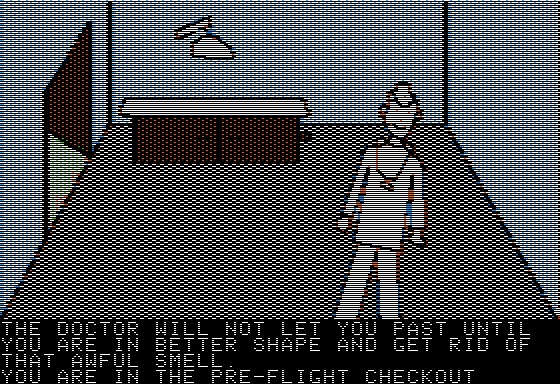
This might be the first game I've played where having bad
BO is a major obstacle.

Once past the doctor, I was able to head out to the airfield and over to the rocket. Inside was a throttle, and four buttons: white, black, orange and blue. These corresponded to left, right, up and down, respectively. Using the throttle launched me into space, where I had to navigate to the asteroid. As I suspected, each move corresponded to a five-minute interval, so it was a simple case of pressing the buttons the right number of times (once for 5 minutes, twice for 10, or thrice for 15), then landing on the asteroid. The need to press the buttons multiple times goes against space physics, of course, but it's hard to see how else this could have been implemented in such a limited parser.

In the space rocket.

The surface of the asteroid was a small maze, made up of just three areas (unless I mapped it incorrectly). The only danger here was suffocation: I needed a spacesuit to survive outside of the ship, and it had a limited oxygen supply. With such a small area to explore I soon found my destination, a cave which contained a deep pit. I set the timer on my explosives, dropped them in the pit, hightailed it back to the rocket and took off.  The asteroid was blown up before it could strike, and the Earth was saved.

Well, that's how it should have gone.  The first time, I dropped the explosives in the right area, but without specifying that I was dropping them in the pit. The explosion didn't fully destroy the asteroid, and it struck the Earth. (I hope it landed right on top of that doctor who insisted I take a shower.)  The second time, I didn't give myself enough time to escape. You have to set the timer on the bomb before dropping it in the pit; I set it too low, and was caught in the explosion.  The third time, I got it right, giving myself enough time to get back to the rocket, retrace my flight plan in reverse to get back to Earth, and watch as my world-saving handiwork took effect.

Oh no, I've been struck by Hugh chunks!

Oddly, the game allows you to continue playing once you've saved the Earth. I wandered around for a bit hoping that some characters might congratulate me, but nothing about the game changes, and when the timer runs out the asteroid destroys Earth anyway. I thought that maybe something was wrong with my copy of the game, but looking around at other blogs I see that this is a universal experience. It makes sense to me when modern games ship with bugs, but in something as small and simplistic as this it's quite baffling. Still, it doesn't affect gameplay at all, so it's hard to complain too much.

Not only does it allow you to keep playing after a victory, but you can keep playing after you've died as well. After the screen shot above I waited around, and at 7:15 the asteroid hit the Earth as scheduled. Then I flew back to Earth and tried to land, only to be told that I'd landed in the ocean and died (presumably because the asteroid had destroyed most of America). So this game is pretty buggy, but at least one outcome has been accounted for.

The victory screen, soon to be invalidated.

Having completed Mission: Asteroid, it's a real case of a game that's on my priority list because of the games surrounding it rather than because of any qualities possessed by the game itself. It's not particularly good or interesting, and it has very little in the way of historical significance, but the Hi-Res Adventure series is important so it's in the queue.  This is going to happen from time to time; heck, it's going to happen a couple of priority games down the line when I hit the Advanced Dungeons & Dragons games for the Intellivision.  It's an inherent drawback with being systematic, I suppose.

RADNESS INDEX:

Story & Setting: The "asteroid colliding with Earth" set-up is a new one, and it's still unusual to find an adventure game with a hard time limit.  The setting is split between mission control headquarters, outer space, and the asteroid itself.  The asteroid and outer space are both disappointingly empty, although I suppose that's realistic.  Mission control has the most content in the game, but most of it's pretty nonsensical. Rating: 1 out of 7.

Characters & Monsters: There really aren't any. The receptionist only responds to the password, the general is a one-time infodump who gets mad if you don't salute, the reporters are only there as a way to lose the game, and the doctor is an absurd obstacle to you getting to the rocket. Characters you can only interact with in one specific way barely qualify as such, so this game is getting a low score. Rating: 1 out of 7.

Aesthetics: The colour graphics here are on a par with those of The Wizard and the Princess, though it must be said that they're not depicting anything nearly as interesting as what's in that game. They're quite ugly, but colour graphics of any kind on a home computer is still refreshing at this point. Rating: 2 out of 7.

Puzzles: The puzzles in this game are dreadfully simplistic, and most of them are signposted heavily within the game. That's a legacy of designing the game for beginners, but I feel like Ken and Roberta took it a little too far. The most difficult part is probably navigating outer space, or finding the asteroid cave before your air runs out. As a small game with simple puzzles it's not going to get a minimum score, but I can't rate it too highly.  Rating: 2 out of 7.

Mechanics: It's a very simple game with very simple commands, but it does what it does reasonably well I suppose. It's tempting to knock it down a point for the false ending, but it doesn't affect gameplay at all. Rating: 3 out of 7.

Challenge: This is definitely one of the easiest games I've played for the blog, but it's short and comes without a great deal of frustration. Rating: 2 out of 7.

Fun: The game may be short, and may be lacking in frustrating elements, but it's also overly linear and gives the player almost no scope to do anything outside of the obvious solutions. Games should at least enable some kind of "play", but Mission: Asteroid just walks the player from one simplistic puzzle to the next. Rating: 1 out of 7.

Bonus Points: 0.

The above scores total 12, which doubles gives a RADNESS Index of 24. That's well below Mystery House and The Wizard and the Princess, and only a little bit above the earliest of Greg Hassett's adventures. It really is one of the least engaging games I've played so far though. It might have been designed for beginners, but I'd be hard-pressed to see it convincing many of them to stick around and play some more adventures.

NEXT: I go back to Eamon to try out its second adventure, The Lair of the Minotaur.  I can't remember a damn thing about playing it, so writing this one up is going to be a test.

Thursday, April 16, 2020

Priority Adventure Game 1: Mystery House (1980)

The cover to the original packaging of Mystery House

I was supposed to post this on the weekend, but with quarantine happening and nothing to do but sit at home, my sleep cycles got so messed up that I basically lost a day or two.  I've been playing a lot of games and catching up with a lot of stuff for the blog, but what I haven't being doing much of is writing.  So today I'm getting back on schedule, and hopefully I'll be able to keep it that way.

Today's game is Mystery House, the first adventure game on my Priority List.  I considered leaving it off, along with the other Sierra Hi-Res Adventures, because I was going to get to them in reasonable time in my regular chronology.  I left the Scott Adams adventures off the Priority List for that very reason.  But the post-King's Quest Sierra games are a definite priority, and I couldn't really justify playing those before covering the company's earlier work.  So the Hi-Res Adventures are in, and the first of those is Mystery House.

The cover of the 1982 re-release, with a playing
card motif that has nothing to do with the game.

Mystery House is often touted as the first graphical adventure game.  It's not, technically; The Atlantian Odyssey, which I covered not too long ago, came out in 1979, so it has Mystery House beat by at least half a year.  It is, however, the first significant graphical adventure.  As history shows, sometimes it doesn't matter if you got there first, what matters most is getting there first in a way that people notice.  Hardly anyone played The Atlantian Odyssey, but a whole heck of a lot of people played Mystery House.

The game was written and designed by Roberta Williams, and programmed by her husband Ken.  Ken Williams had spent the 1970s working in the business side of computers, bouncing from company to company, always seeking a bigger paycheck.  He'd mostly worked on mainframes during that time, and he bought an Apple II with the plan of creating a version of the FORTRAN programming language that would work for it.  As it happened, among the applications he had for that Apple II was a copy of Colossal Cave Adventure.  Roberta, who is usually described as the model housewife and mother before this moment, became obsessed with the game, and even she admits that she neglected her children while playing it.  After she finished it there were few options for similar games, and she thought that she'd be able to make her own, as long as she had someone to do the coding.  Ken eventually came around to the commercial potential of making such a game, especially when the idea of adding graphics came in, and it became the first hit for On-Line Systems, later known as Sierra On-Line.  Overall it's said to have sold about 80,000 copies, which is a huge number for the time. You probably know the rest: Roberta would go on to spearhead the King's Quest series, Sierra would be the biggest force in adventure gaming throughout the 80s and into the 90s, and the two of them combined would be major players in helping video games to become a part of pop culture at large.  (For a more detailed look at the early years of Ken and Roberta, check out this article over at the Digital Antiquarian.)

The original title screen. The re-release adds a few more with the Sierra
logo, and a page of text about the public domain release.

Mystery House was released on May 5, 1980 for the Apple II, and later ported to a bunch of Japanese computers.  (I do find it odd that the game wasn't ported to any other computers in the US.  It seems especially strange that money-hungry Ken Williams wouldn't have seized the opportunity to get his games onto, say, the Commodore 64.  Perhaps there was a technology issue, but I have no idea.)  I am, of course, playing the Apple II version on an emulator.  I couldn't find the original; all the versions out there are from 1987, when the game was released into the public domain to celebrate Sierra's 7th anniversary.  (Why celebrate the 7th?  You couldn't wait three years?)

The plot of Mystery House was apparently inspired by the Agatha Christie novel And Then  There Were None.  I've never read any Christie, but looking at a plot summary it seems that the connection is very loose.  Both stories feature a group of people who've been invited to a house, and are murdered one by one.  There all similarities end.

In addition to its credit as the first graphical adventure, Mystery House also sometimes gets credited as the first adventure game to have a mystery story.  That's probably not the case: the similarly-named Mystery Mansion (which I covered back here) has it beat.  Of course, Mystery Mansion was developed over a span of years from 1978 to 1981, so there's a small chance it wasn't quite playable by the time Mystery House was released.  It's only a small chance though; evidence points to Mystery Mansion being played in the 1970s, and there are some claims that it was created even earlier than 1978.  Regardless of that, Mystery House gets the credit for being the first mystery game that a large number of people played.

This is probably the best-looking screen of the game.  Just ignore the tree.

The game begins with the player standing outside the titular house.  There's nothing else to do but go up to the front door and enter, after which the door is slammed and locked behind you.  You are now trapped in the house, along with seven other people whose depictions I could best describe as amateurish.

They all look identical here, but will get unique depictions later on.

You can't get descriptions of any of these people during the game, but the instructions have more details as to who they are:

  • Tom, a blond plumber
  • Sam, a brunette mechanic
  • Sally, a red-headed seamstress
  • Dr. Green, a brunette surgeon
  • Joe, a brunette gravedigger
  • Bill, a blond butcher
  • Daisy, a blond cook

Is it weird that there are three blokes here described as brunettes?  I always thought that was more of a female descriptor.  Regardless, as soon as I saw these descriptions, I figured that hair-colour would play some role in solving the mystery.

As well as the seven other guests, the entry hall also has a crude note on the floor.

They were going to write "losers weepers" but they ran out of space.

"Valuable jewels are hidden in this house.  Finders-keepers."  This level of atrocious hand-writing at first led me to suspect Dr. Green, but then I realised that the writing was legible, so I abandoned this theory.  Besides, you can't accuse anyone of the murder, or even talk to the other guests.  You can't even kill any of them yet, and it's not like an actual crime has been committed at this point.  There's nothing to do but leave the room by one of the three doors, or by the stairs to the top floor.  As soon as you leave, the other guests all disappear from the entry hall.

West of the entry hall is a kitchen, which has a fridge, a cabinet, and a stove.  It has a sink as well, which is shown in the graphics but not mentioned in the room description.  This stumped me for a little bit, because I was only interacting with the items that the game went out of its way to mention.  I opened the cabinet, and found some matches.  I opened the fridge, and found an empty pitcher.  I ran into some problems here, though, because I just couldn't figure out what to call the thing in the fridge.  I tried JUG and GLASS and even EWER, because I read far too much fantasy fiction with old-timey words.  It wasn't until much later that I hit on PITCHER, and I can't even tell you why it took me so long.  I can say that it's not the word I'd use in that context: it's a god-damn JUG, I tell ya!  None of this would have been a problem if it was described in the text.

I also tried lighting the stove, and got a very terse message telling me that the stove exploded, and I was dead.  One quick reload later, I determined that the stove was probably unimportant, and not to be tampered with.  Chalk that up as my first arbitrary death in a Sierra game.  Alas, this one didn't have the charm of their later games.

You can leave the kitchen by a back door, but that just leads into a forest maze, and I wasn't prepared for maze mapping at this early stage, especially without a full inventory to leave a trail.  I couldn't figure out how to get back to the kitchen though, so after getting hopelessly lost I had to reload again.

This time I went east from the kitchen and found the library, complete with seven whole books.  There is a cobweb in the corner though, and most of the windows in the house are boarded up, so I assume the place has been abandoned for some time.  I found a note on the floor, which had another crudely written message: "7-6 = 1. THEN I AM DONE!"  Ooh, foreshadowing!  What could this possibly mean!  (Obviously it means there will be murders.  But if there are seven guests plus me, this murderer's math is all screwed up. Perhaps I was not expected?)

Another door led outside where I found the first murder victim: Sam the mechanic, who had been hit on the head by a blunt object. Look, you can see the big lump on his head!  And those X's for eyes, he's as dead as a doornail.

Alright, one less person looking for the treasure!

I went back inside through another door, into a dining room. I could see that there was a candle on the table, and... something in the background.  A christmas tree?  A tent?  Eventually I figured out that it's a lamp, but it doesn't matter, because it's irrelevant.  It does highlight one my biggest gripes with early graphical adventure games though, and it's their expectation that you'll know what the objects depicted in the graphics are supposed to be.  It happened earlier with the pitcher, and it's happened again here with the lamp.  This won't be such a problem later, when graphics get better and room descriptions get longer, but in this era of crude images and terse descriptions it really sucks.

An illuminati symbol?  A dwarf holding a kite?

After a short time the sun goes down, and if you don't have a light source by then it's pretty difficult to navigate (although you can still fumble around in the dark).  I used the match to light the candle, but when I lit it in the dining room I tripped on the rug and started a fire.  I tried leaving by the back door, but that only resulted in my fiery death.  After a reload, I figured out that you can take the candle out of the dining room first before you light it. Crisis averted!

Having explored all of the ground floor I went upstairs (a floor which is inexplicably larger than the one below it, unless the rooms on the bottom have a much bigger volume).  Heading east and west I found four bedrooms.  In the nursery I found the body of Dr. Green, which disproved my bad hand-writing hypothesis.  He had been stabbed, but there were no other clues to be found.

In a boy's bedroom I found another note, that said "YOU WILL NEVER FIND IT! IT'S ALL MINE!!"  In a large bedroom I didn't find anything, but someone tried to kill me with a thrown dagger.  I grabbed the dagger and gave chase, but whoever it was had quickly vanished.  (Replaying the game to get some screenshots, I just had this dagger thrown at me even though I'd already taken care of the murderer.)

The last bedroom had another body, that of Sally the Seamstress.  She'd been bumped on the head just like Sam, but this time there was another clue: a blond hair!  My list of suspects was rapidly dwindling: only Tom, Joe, Bill and Daisy were still alive.  Of those, Joe was a brunette, so he was probably ruled out.

Heading north I saw a stairway up to the attic, but I decided to explore a doorway at the end of the passage first.  It led to a study, with nothing inside but a desk that I couldn't interact with, and a window with a lovely view outside.  Next to the study there was a bathroom, where I found yet another murder victim: Bill the butcher, who had been strangled with a pair of pantyhose.  I mean, it's possible that this is a Michael Hutchence situation here, but it's probably safer to assume that this guy was murdered.  Based on the graphics, I miraculously figured out that you can take a towel from the rack.  You can't use the toilet, though, which is a bit of a black mark on the game.  If you're putting a dunny in a game, you better let me take a shit in it, that's all I'm saying.  (Actually, this game doesn't even let you type any cuss words.  Try it, and you get hit with an instant game over.)

Heading up to the attic, I found a hammer, which I took, and a ladder that was too heavy to move.  In a storage room just off the attic there was a chest, which was locked.  I guess I'd have to go looking for the key.

At that point I'd pretty much explored everywhere, or so I thought.  I mapped the maze, but I didn't find anything there: it was just a pointless maze of trees that didn't seem to go anywhere.  I did figure out that you could leave the forest by going UP from the initial location, which doesn't make much sense, but it did come in handy later.  I also noticed the gate in the back yard, which led to a graveyard.  There I found Joe the gravedigger, who had just finished digging six graves.  I tried to take his shovel, thinking that maybe I needed to dig somewhere in the forest to find the key.  Joe wouldn't let me, so I stabbed him to death.  Him digging six graves was highly suspicious behaviour, so I'm sure he deserved it.  Digging in the forest didn't turn anything up though, so I was a little bit stuck.

Hahaha the giant X's on his eyes.

Eventually I noticed the sink in the kitchen, and figured out that I could turn the taps on with the dubious command of WATER ON.  That one's pretty rough, but it was singled out in the instructions so I remembered it pretty quickly.  I gathered some water with the pitcher, and also took a butterknife that was lying in the sink.

With some water in my possession I figured that I had some fire-fighting capabilities, so I went back to the dining room, where I once again tripped on the rug and set it ablaze.  Pouring water on the fire put it out, which left a hole in the rug.  In that hole I found a key, and with that key I was able to unlock the chest, in which I found a handgun with one bullet.

I'll never turn down a gun in any game, but this wasn't the clue I was hoping for.  I'd found four dead bodies, and made one myself by killing Joe.  That left Tom and Daisy, one of whom was probably the murderer.  They weren't coming to me it seemed, so it looked like I'd have to find them.  And what's a murder house mystery without a secret passage?

I started rechecking all of the rooms, and eventually I found my solution in the study.  Here's a picture of that room, with it's lovely window view.

It still looks like a window to me.

While I was looking around the house I tried to look out this window, and was told that all of the windows on the house were boarded up, except for the one in the attic.  The attic window only gives a view of the forest, with nothing helpful to impart.  But if all the other windows were boarded up, what about this one in the study, which was very clearly open?

Well, it turns out the graphics fooled me again, because this was not a window but a painting in a picture frame.  The picture was bolted to the wall with four screws, but I was able to loosen them with the butterknife from the kitchen.  (The dagger should maybe work here, but it doesn't.) Behind the picture was a button, and pressing it opened a secret door.

This secret passage led down to the basement, where I found the final corpse: that of Tom the plumber.  He'd been stabbed, and was clutching a daisy in his hand.  Even I could understand such boneheaded symbolism, and with this clue and the process of elimination I figured out that Daisy was the murderer.  Now I just had to find her.

Poor Tom, he'd only just been awarded the key to the city.

It was impossible not to notice the huge key on the table, which was a skeleton key.  Obviously it's called that because the ginormous bloody thing was carved out of an elephant's thighbone.  The door out of the room led to a pantry, with no way through.  Later on I figured out that it connected to the kitchen, through a hole behind the cabinet that was bricked up.  I had to used the hammer from the attic to smash the bricks to get through.

There's also a tunnel leading from the basement, which somehow led to an area with a large pine tree.  I tried climbing the pine tree, and found a telescope.  Looking through it, I could see into the attic through the open window, where I spotted a trap door in the ceiling.  Why I could see this through a telescope from outside better than three feet away with my actual fucking eyes I have no idea.  There was nothing else to do but head back down the tree, which dumped me in the middle of the forest maze.  I was thankful at this point that I'd mapped it out, and getting back to the house wasn't too hard.

Heading to the attic, I climbed up through the trapdoor, and found myself in a tower with the murderer, Daisy.  Examining her gave me the unambiguous message "She is going to kill you", so I unloaded by gun right into her face.  I'd stopped the murderer!  And well, murdered a couple of people myself, but they deserved it.  I still think Joe was in on it.  (My replay only strengthened this theory, because somebody threw a dagger at me after I'd already shot Daisy's head off.  I reckon she killed the victims that were stabbed, and Joe killed the ones that were bashed on the head using his shovel.)

This worked, actually.

In the attic I found another note, that said "It's in the basement!"  So I went down to the basement, and started typing things like BREAK WALL and FIND SECRET and END ALREADY.  I noticed that the walls were covered with algae, and I even tried CLEAN ALGAE, but that didn't work.  I was stuck on this for quite some time, until I eventually caved and looked up the solution.  It was WIPE ALGAE, or RUB ALGAE, so I was on the right track, I just hadn't gotten the wording right.  You need the towel here as well, or the game tells you that you have nothing to wipe the algae with.  With the algae cleaned away, I found a loose brick, and behind that I found the jewels.  With the murderer dead and the jewels in my possession, I was able to leave the house and win the game.

A guru wizard?!?

So, Mystery House.  I can't say that I enjoyed it, exactly.  Wrangling with the combination of a primitive parser and bad graphics was a trial at certain points. It's not like the mystery story was any great shakes either, and you don't even really solve it except by the process of elimination. But there were certain aspects of the game that were impressive, most notably the graphics.  Not that they look good; they are, in fact, rather terrible.  But the changes to the game environment being reflected graphically is definitely impressive for the time.  Doors open and close.  Items disappear when you pick them up, and will appear in any location when you drop them.  I don't recall any games doing this before.  It's one impressive thing in a see of irritations, though, and I can't really recommend Mystery House as anything other than a historically significant curiosity.

RADNESS INDEX:

Story & Setting: The mystery story is still a novel one at this point, and I appreciated the change, but it's really not at all well executed.  And, of course, there just has to be some treasure to find, doesn't there?  The house isn't particularly well realised either, although adding the graphical dimension makes it a little more memorable.  I'm wavering between 1 and 2 here, but I think perhaps I'll be generous. Rating: 2 out of 7.

Characters & Monsters: This category starts promisingly, but it turns out that the characters here are little more than corpses to be strewn throughout the game.  Only Joe and Daisy are found alive after the initial room, and they can barely be interacted with.  Rating: 1 out of 7.

Aesthetics: This is a pretty ugly game, and the novelty of the graphics doesn't really mitigate that.  There's no sound, and the writing is terse.  The game does do some novel things with its graphical interactivity, but I'm dealing with that down in Mechanics.  Plus you lose points here when I have to spend significant time trying to figure out what an object actually is.  Rating: 1 out of 7.

Puzzles: The puzzles in this game aren't actually too bad.  Most of them are pretty simple and logical, they're just hopelessly obscured by the graphics and the parser.  None of them are particularly clever though.  Rating: 2 out of 7.

Mechanics: The parser is really not all that good, and as I've said the graphics don't help it.  It's not hopelessly broken though, and the interactivity of the graphics earn it an extra point here.  Rating: 3 out of 7.

Challenge: It's an often-baffling game, but I wouldn't say it's a particularly hard one.  Without the graphics and parser issues I've already mentioned it would probably rate a little better here, but with them I would have to say that this game is a frustrating experience. Rating: 2 out of 7.

Fun: I didn't enjoy Mystery House a great deal once I got through the initial exploration, mostly due to the issues above.  It's pretty short though, and that's usually enough to get a game out of a minimum score in this category.  Rating: 2 out of 7.

Bonus Points: 2.  For graphical innovation and historical significance I grant this game the full amount of bonus points.

The seven categories above add up to 13, which doubled totals 26.  Add the two bonus points, and Mystery House gets a RADNESS Index of 28.  That places it equal 24th overall, and 15th out of 26 adventure games.  It's even with Voyage to Atlantis and just above The Cottage, which was probably an even more frustrating experience than this one.  So it's down there with some of the games I've not enjoyed much, but not right down there with the very worst.

NEXT: My next game was going to be Empire of the Over-Mind, Gary Bedrosian's follow-up to Lords of Karma, which I rather liked.  But although he wrote it in 1979, it wasn't released until 1981, so I'm kicking it down the list by a couple of years.  After that I had Enchanted Island by my boy Greg Hassett, but it looks like that's his last game for 1979: before that he wrote Sorcerer's Castle Adventure.  So I'm swapping the two around, and by the weekend I should have a post up on Sorcerer's Castle.